

04.06.2026
Quick Look on the EXSOTHyC Stack
A new AEL stack design has been developed through the EXSOTHyC Project
As green hydrogen becomes an increasingly important part of the clean energy transition, there is a growing need for electrolysis systems that are more efficient, reliable, and cost-effective. The EXSOTHyC project is addressing this challenge through the development of a next-generation alkaline electrolyser stack designed to operate at lower voltages and higher efficiencies than conventional systems.
Recently, Stargate Hydrogen finalised the design of the stack for the EXSOTHyC project which features development approaches on improving long-term operational performance. The project combines advanced catalyst materials, innovative electrode architectures, improved diaphragm integration, and novel stack design concepts to optimise the entire electrochemical system. A quick look of the design can be seen below.
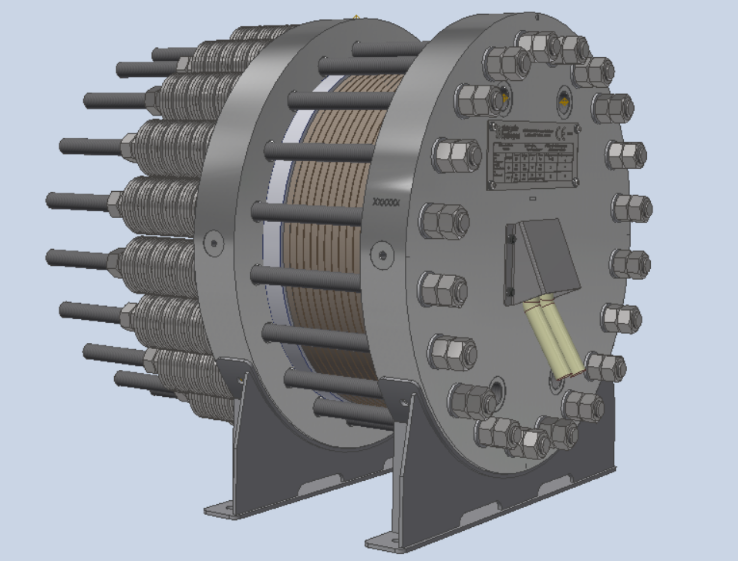
At the centre of the project is the use of exsolution-based catalyst materials, a new class of ceramic-derived materials capable of forming highly active and stable nanoparticles under operating conditions. These materials are being integrated into porous three-dimensional electrode structures to improve electrochemical activity, robustness, and resistance to degradation during long-term operation.
The EXSOTHyC project also explores new membrane-electrode assembly concepts, including catalyst-coated diaphragms and improved electrode-diaphragm interfaces, with the goal of reducing gas crossover and enhancing stack efficiency, particularly under dynamic operating conditions. Alongside materials innovation, the stack architecture itself is being redesigned to improve electrolyte flow distribution, gas management, thermal stability, and overall system reliability.
A major objective of EXSOTHyC is to validate a short-stack prototype incorporating these disruptive technologies and to establish a pathway towards larger-scale commercial deployment. By combining advanced materials research with practical stack engineering and system integration, EXSOTHyC aims to contribute to more efficient, durable, and economically competitive green hydrogen production technologies for the future energy transition.
This milestone in the EXSOTHyC project is made possible by the research, knowledge, and contributions of the consortium partners, namely, Agfa, Fraunhofer IFAM Dresden, Eindhoven University of Technology, University of St. Andrews, and Stargate Hydrogen. An ongoing support from the Clean Hydrogen Partnership co-funded by the European Union was vital in bringing this project to life.